
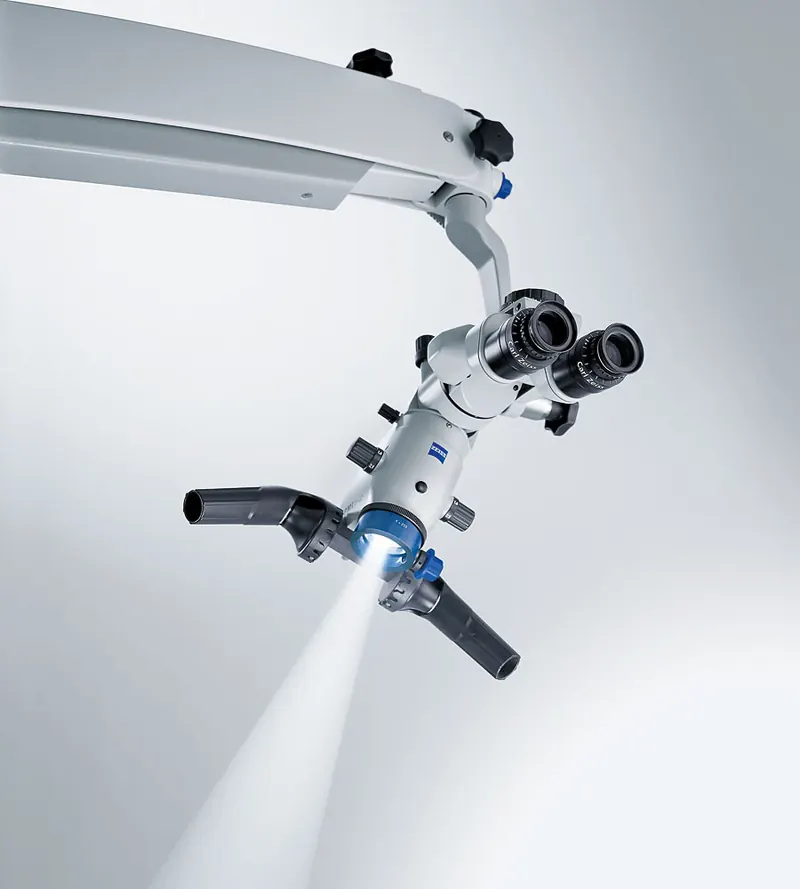
What is a dental operating microscope?
A dental operating microscope is a magnifying instrument, mounted on an arm above the dental chair, that gives the dentist an enlarged and brightly lit view of the tooth being treated. AMK Dental Clinic uses a dental operating microscope for microscope-assisted dentistry.
Dental microscopes offer adjustable magnification, commonly from about 4x to 25x, grouped into low, medium and high settings for different tasks (American Association of Endodontists). The light travels along the same path as the dentist’s view, which reduces shadows inside the tooth.
How is the microscope used at AMK Dental Clinic?
AMK Dental Clinic uses the microscope in several types of treatment where seeing small details matters.
Root canal treatment. Root canal treatment removes infected or damaged pulp from inside a tooth, then cleans and fills the space (teeth.org.au). Canals can be very narrow, curved or partly blocked by calcium deposits. Magnification helps the dentist locate canal openings, including extra canals that can be missed, and remove obstructions (World Journal of Methodology).
Fillings. The microscope helps the dentist see the boundary between decayed and healthy tooth and check how well a filling seals at its edges.
Crown preparation. When a tooth is shaped for a crown, magnification helps the dentist check the edges of the preparation, which the crown needs to fit against. Our CEREC same-day crowns page explains how crowns are made.
Checking for cracks. Fine cracks can cause pain on biting and may be hard to see. The microscope, with bright light, can help show crack lines in enamel and inside the tooth (American Association of Endodontists).
What are the benefits and limits of using a microscope?
The main benefit of a dental microscope is that magnification and focused light help the dentist see fine detail. This supports finding hidden canals, seeing cracks, and working carefully around healthy tooth structure.
A microscope also has limits. At higher magnification the field of view is narrower, and some procedures take longer (World Journal of Methodology). Research clearly shows better visibility, but evidence on whether microscopes improve long-term root canal success is mixed. A microscope does not change the risks of the treatment it is used for.
What should you expect at a microscope-assisted appointment?
A microscope-assisted appointment at AMK Dental Clinic feels much like any other dental appointment. You lie back in the chair, and the microscope is positioned above your mouth without touching you. Local anaesthetic is used where the treatment normally needs it.
Because the dentist is looking through the microscope, you may be asked to hold your head still or turn slightly at times. We will explain what is happening, and you can raise your hand to pause whenever you need to.
What are the risks of treatment?
The risks depend on the treatment being carried out, not on the microscope. For example, root canal treatment can still fail or need retreatment, instruments can occasionally separate inside a canal, and a treated back tooth usually needs a crown to reduce the risk of fracture (teeth.org.au).
Cracked teeth may still need extraction if a crack extends too far. Crowns can loosen or chip, and the tooth underneath can still decay (healthdirect). Your dentist will explain the specific benefits, risks and alternatives of your treatment before you start.
Who might benefit from microscope-assisted dentistry?
Microscope-assisted dentistry may be useful if you need root canal treatment, have a tooth with suspected cracks, or are having a filling or crown where fine detail matters. Not every appointment needs a microscope; routine check-ups and cleans are done without one.
Some complex cases, such as retreatment of a previous root canal or surgery at the root tip, may be referred to a dentist with specialist registration in endodontics. If that applies to you, we will explain why and help arrange it.
Common questions
Why do dentists use a microscope?
Dentists use a dental operating microscope to see fine detail that is hard to see with the naked eye. The microscope magnifies the tooth and shines a bright light directly into the area being treated. This can help the dentist find small root canals, see fine cracks, check the edges of fillings and crowns, and remove decay or old material with more visual control.
Does a microscope make root canal treatment more successful?
Research shows that magnification helps dentists locate hard-to-find canals and see cracks, but the evidence on whether it improves the long-term success of root canal treatment is mixed. A 2025 review in the World Journal of Methodology noted that some systematic reviews found no clear evidence of better success rates. The microscope is a tool that supports careful treatment, not a guarantee of outcome.
Does microscope dentistry feel different for the patient?
For most people, treatment with a microscope feels much the same as other dental treatment. The microscope sits above you and does not touch you. Local anaesthetic is used where the treatment normally needs it. Some appointments may take a little longer because the dentist is working in fine detail. You can ask to stop for a break at any time.
Can a microscope find cracks in teeth?
A dental operating microscope can help the dentist see cracks in teeth that are difficult to see otherwise, especially when combined with bright light and dyes. It cannot always show how deep a crack goes or whether it reaches the root. Your dentist uses the microscope alongside your symptoms, bite tests and X-rays to judge whether a cracked tooth can be kept.