What is a dental operating microscope?
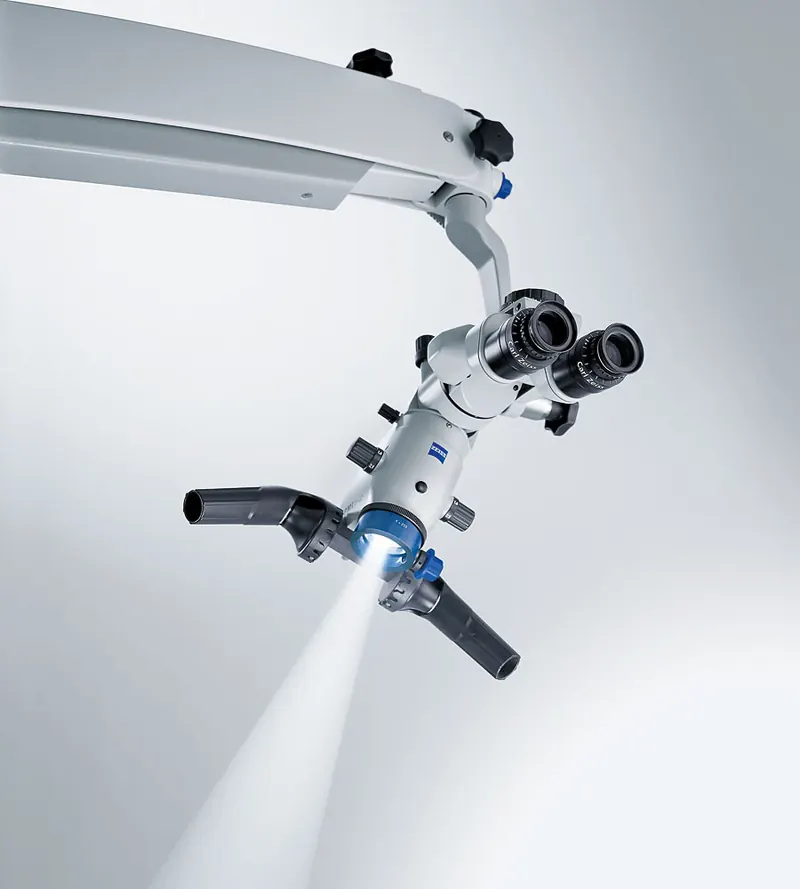
A dental operating microscope is a magnifying instrument mounted on an arm above the dental chair that gives the dentist an enlarged, brightly lit view of the tooth being treated. It is the tool behind microscope dentistry at AMK Dental Clinic in Mortlake.
Typical dental microscopes offer adjustable magnification, commonly from about 4x to about 25x, with low, mid and high settings for different steps (American Association of Endodontists). Light is directed along the same path as the dentist’s view, which reduces shadows inside the tooth.
The microscope does not replace X-rays, your symptoms or a careful examination. It is one way of seeing the treatment area in more detail while care is underway.
What can magnification help a dentist see?
Magnification and focused light can help a dentist see structures that are hard to see with the naked eye, including narrow root canals, fine crack lines, and the edges of fillings or crown preparations.
During root canal treatment, the soft tissue inside the tooth (the dental pulp) is removed, the space is cleaned and disinfected, and it is filled. Canals can be very narrow, curved or partly blocked. Reviews of the dental operating microscope describe help with locating canal openings, removing calcifications and seeing crack or fracture lines (American Association of Endodontists; World Journal of Methodology).
For restorative care, magnification may help the dentist check the boundary between decayed and healthier tooth structure and inspect how a filling or crown margin sits against the tooth. High magnification narrows the field of view, so the dentist chooses a level that suits the step being done (World Journal of Methodology).
Seeing more detail supports careful work. It does not mean every problem can be found or fixed, and your dentist still combines what is seen under the microscope with your history, clinical tests and images.
When might AMK use a microscope?
AMK Dental Clinic may use a dental operating microscope when fine visual detail matters for the treatment planned for you. Common examples include root canal treatment, some fillings, checking crown preparation edges, and looking for cracks that may explain biting pain.
Not every visit needs it. Everyday general dentistry check-ups and cleans are usually carried out without the microscope. If a more complex root canal problem needs care beyond what is suitable in general practice, your dentist may discuss referral to a dentist with specialist registration in endodontics and help arrange that if needed.
If treatment is recommended, you receive an itemised written estimate before anything goes ahead. Your dentist will discuss the benefits, risks and alternatives so you can decide what suits you.
What are the limits of microscope dentistry?
Microscope dentistry has clear limits: better vision does not remove the risks of the underlying treatment, and it does not promise a better clinical outcome for every person.
Professional discussion has long included whether magnification improves long-term root canal success. An American Association of Endodontists review noted debate on outcome rates and summarised systematic reviews that found it was still unknown whether magnification devices changed nonsurgical endodontic outcomes, because many other factors also affect success (American Association of Endodontists). Later research is not uniform. Visibility gains are clearer in the literature than proof of better long-term results in every case, and this page does not claim better outcomes.
Practical limits also apply. At higher magnification the field of view is narrower, and some steps take longer while the dentist works in fine detail (World Journal of Methodology). Root canal treatment can still fail or need retreatment; a cracked tooth may still need to be removed if a crack extends too far (teeth.org.au). Results vary between people.
How do I ask about microscope-assisted care at AMK?
Ask your dentist whether microscope-assisted care is planned for your treatment, and what they expect it to help them see in your case. You can raise this at a consultation, by phone, or via the Contact page.
AMK Dental Clinic is at Shop 3, 46 Tennyson Road, Mortlake NSW 2137. Call (02) 9739 6525, or contact us to book. Opening hours are listed on the Contact page. We see patients from Mortlake and nearby suburbs including Breakfast Point, Cabarita, Concord, Rhodes and North Strathfield.
For a fuller overview of how the practice uses the instrument, read our microscope dentistry service page. This blog is general information only. It is not a personal diagnosis or treatment plan. Ask your dentist what is suitable for you.
This article is general information only and is not a substitute for advice about your own situation. Please speak with a dentist about your needs.
Common questions
Does a dental microscope touch the patient?
No. A dental operating microscope sits on an arm above the chair and does not touch you. The dentist looks through it while treating the tooth. Local anaesthetic is used when the treatment itself needs it. Some appointments may take a little longer because the dentist is working in fine detail. Ask at AMK Dental Clinic in Mortlake if you want to know whether the microscope is planned for your visit.
Does using a microscope mean better treatment results?
Magnification and focused light help the dentist see fine detail, such as narrow canals or crack lines. Research and professional reviews note clearer vision, but evidence that microscopes improve long-term root canal success is mixed. An American Association of Endodontists review discussed debate on outcome rates and older systematic reviews that could not show a clear effect. Results still vary. Ask your dentist what is suitable for you.
Will every appointment at AMK use the microscope?
No. Routine check-ups and cleans are usually done without a microscope. AMK Dental Clinic may use microscope-assisted dentistry when fine detail matters, for example during root canal treatment, some fillings, crown margin checks or looking for cracks. Your dentist will explain if it is planned. If treatment is recommended, you receive an itemised written estimate before it goes ahead.